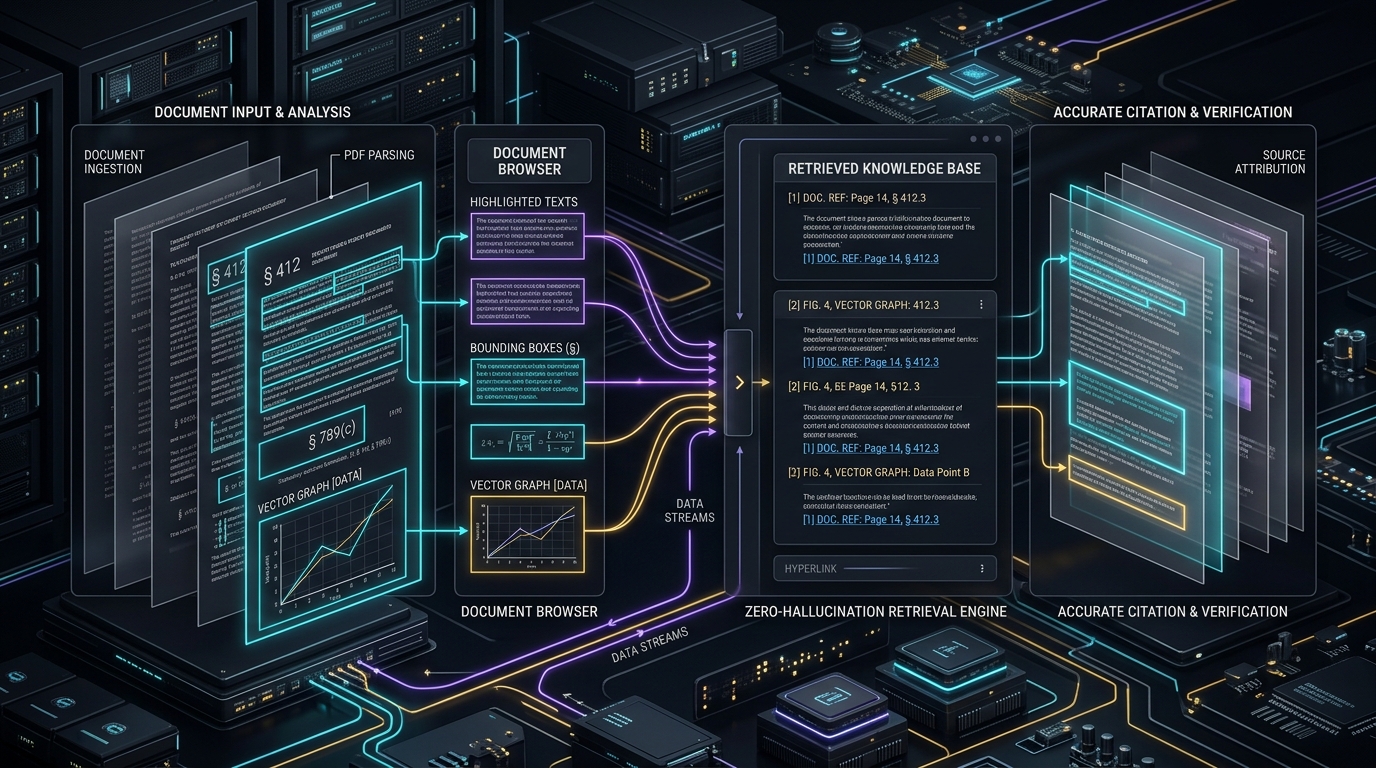
1. The Failure Demo: One Document End-to-End
To understand why citations break, consider a single real test fixture from the repository: sample_contract.pdf.
Step 1: Raw Page Text
COMMERCIAL LEASE AGREEMENT
Section 8.22 Permitted Use of Premises
Premises shall be used exclusively for commercial office space and professional services.
No retail or hazardous materials storage is permitted without Landlord's prior consent.
Step 2: What Default Splitters Emit
In a standard LangChain ingestion setup using RecursiveCharacterTextSplitter(chunk_size=1000, chunk_overlap=200) with default PDF extractors:
# Default Ingestion Output
{
  "text": "...prior lease provisions. COMMERCIAL LEASE AGREEMENT Section 8.22 Permitted Use of Premises Premises shall be used exclusively for commercial office...",
  "metadata": {
    "source": "sample_contract.pdf"
    # Notice: page number is missing or estimated by character offset;
    # subsection boundary is sliced mid-sentence;
    # bounding box coordinates are completely absent.
  }
}
When an LLM retrieves this chunk, it has no record of whether Section 8.22 was on Page 1, Page 3, or in an exhibit. If prompted for a page citation, it must hallucinate one from context words.
Step 3: What KruschNexus Emits
Here is the actual serialized JSON emitted by KruschNexus (v0.2.5) for the query "commercial office space Section 8.22":
{
  "schema_version": "1.0",
  "citation": "sample_contract.pdf p.1 Section 8.22 Permitted Use of Premises",
  "page_number": 1,
  "header": "Section 8.22 Permitted Use of Premises",
  "heading_path": [
    "Page 1",
    "Commercial Lease Agreement",
    "Section 8.22 Permitted Use of Premises"
  ],
  "char_start": 0,
  "char_end": 66,
  "bbox": [50.0, 83.38, 212.75, 41.1],
  "match_reasons": ["dense_rank_1", "sparse_rank_1", "section_locator_match"],
  "text": "COMMERCIAL LEASE AGREEMENT\n\nSection 8.22 Permitted Use of Premises",
  "score": 0.11279,
  "used_ocr": false
}
Step 4: The Round-Trip Check
I verify this contract directly in tests/unit/test_span_locator.py:
# Round-trip verification:
extracted_text = parser_result.pages[hit.page_number - 1].text
# Slice page text using exact retrieved character span bounds:
assert extracted_text[hit.char_start:hit.char_end] == hit.text
# Bounding box coordinates [50.0, 83.38, 212.75, 41.1] correspond to physical PDF points
assert hit.bbox == [50.0, 83.38, 212.75, 41.1]
Step 5: Hard Negative Rejection
If a query asks for "Section 8.22.030(C)" (a tenant relocation penalty from an Oakland municipal code fixture), KruschNexus does not match Section 8.22 of the lease, despite sharing 85% of token characters. The section-aware parser differentiates between the parent statute and specific sub-clauses, returning an empty set if the exact subsection does not exist.
2. Ingestion Pathology: Where Locators Die
Three specific defects in standard RAG pipelines destroy locator fidelity:
- Page erasure: Most libraries linearize a document into a single text stream before splitting. The physical page boundary is lost, forcing models to guess page numbers from nearby text.
- Section truncation: Fixed-window chunkers split statutory sections (e.g.
§ 1950.5(b)(2)) mid-clause across two records. Neither chunk matches a clean exact-section search. - Two-column interleaving: Multi-column ordinances and contracts are linearized horizontally across the page. Line 1 of Column A merges with Line 1 of Column B, producing syntactically plausible gibberish that corrupts dense embeddings.
3. The Product Boundary: Decoupling Three Claims
"Zero-hallucination citations" is often used as a vague marketing slogan. In KruschNexus, I explicitly separate three distinct technical claims:
- Provenance fidelity (Core Product Promise): The text snippet retrieved really is that exact text, on that physical page, at those bounding box coordinates on disk. I test and guarantee this.
- Retrieval quality (Measured & Incomplete): The most relevant span was ranked first in the top-k results. I measure this empirically across test fixtures, but make no universal claims across unseen corpora.
- Generation honesty (Consumer Responsibility): A downstream language model will not misread, embellish, or fabricate facts from a valid span. This belongs strictly to the consumer's prompt and LLM layer.
| Architecture Layer | LangChain Splitter + pgvector Cosine | KruschNexus (v0.2.5) |
|---|---|---|
| Responsibility | Full-stack wrapper (Chat UI + Prompts + Agent Loops + Vector Search) | Dedicated Corpus Factory & Citation Spine. Emits verified spans for other tools. |
| Citation Target | Estimated page number from token index | Physical Page, Character Offsets, & PDF Bounding Box |
| Low Relevance Behavior | Returns top-k nearest neighbors regardless of cosine distance | Fail-Closed: Returns empty list [] below similarity floor ($0.45$) |
| Schema Stability | Ad-hoc JSON dicts drifting between commits | 1-Page Frozen SemVer Contract verified by CI golden schema tests |
In version 0.2.0, I stripped the internal chat interface and LangGraph experimental loops. Removing the conversational layer preserved KruschNexus as a stable, testable ingestion utility that other agents consume via Python SDK or FastMCP.
4. The Parser Spine: Layout-Aware Blocks, Page Truth, & Monotonic Lineage
Document ingestion fails when parsers treat structured human documents as flat text streams. KruschNexus v0.3.1 enforces a layout-aware block model and a strict dual-coordinate page truth system:
- Native Structure Over Heuristic Regex: Where native document structure exists, KruschNexus extracts it authoritatively:
- Word XML (DOCX): Maps native paragraph styles (
Heading 1throughHeading 6,Title,Subtitle) and table cell boundaries directly into typedContentBlockinstances with explicit hierarchy levels. - HTML & Rich Text: Maps semantic
<h1>–<h6>elements and table structures natively, eliminating brittle regex guesswork.
- Word XML (DOCX): Maps native paragraph styles (
- Proposer-Rejecter Layout Guard: Regex is restricted to a fallback proposer on untyped text, governed by a strict syntactic rejecter:
- Mid-Paragraph Burial Rejection: Statutory citations buried mid-sentence (e.g. "...pursuant to the covenants set forth in ARTICLE IV. Neither party shall...") are rejected as section headers by inspecting preceding prose tokens (
under,pursuant to,in accordance with) and line length, preventing section hallucination. - Noise Line & Footer Suppression: Running footers, page numbering lines ("Page 3 of 12"), Bates stamps (
PLAINTIFF_0001234), and dotted TOC leaders (. . . . . 12) are suppressed from heading candidacy and chunk embedding bodies.
- Mid-Paragraph Burial Rejection: Statutory citations buried mid-sentence (e.g. "...pursuant to the covenants set forth in ARTICLE IV. Neither party shall...") are rejected as section headers by inspecting preceding prose tokens (
- Page Truth as a First-Class Coordinate System: Document viewers navigate by 1-based physical pages; legal folios cite printed numbers that often diverge after unnumbered covers or roman-numeral tables of contents. KruschNexus explicitly tracks both:
pdf_page: 1-based physical sheet index matching PDF viewport jump commands.printed_page: Observed printed folio (e.g. "Exhibit B-1", "Page 4 of 12"). When they diverge, the citation engine formats the citation asp.4 [printed: 3]so both machines and human attorneys can verify it instantly.- Format Honesty: Unpaged formats (DOCX, HTML, CSV) keep
page_number=Nonerather than fabricating synthetic page numbers.
- Physical Page Boundary Chunk Flushing: To guarantee locator truth, sliding-window chunkers are strictly forbidden from crossing physical page boundaries in paged formats (PDF). When the page index increments, the accumulator is flushed, ensuring every chunk maps 1:1 to a single verifiable page.
- Monotonic Heading Stack: Heading paths are maintained as an observed stack (
Page 1 > Section 8.22 Permitted Use) with monotonicity tracking, guaranteeing parent-child hierarchy across multi-page sections. - Optional Local Neural Layout Adapter (Docling / Marker): Pluggable neural layout adapters (
pdf_backend="docling"or"marker") emit the exact samePageDataandStructuredLocatorcontract with seamless Poppler airgap fallback. - Parent ↔ Exhibit / Attachment Lineage Manifests: Automatically extracts parent ↔ child document lineage via
client.get_exhibit_manifest(doc_id), exposed across FastMCP and REST without polluting chunk text. - Format-Honest Citations: Spurious
§symbols are eliminated from tables, exhibits, and attachments—producing citations like"Lease.pdf p. 12 Exhibit A"or"Matrix.csv Row 14".
5. Retrieval: 4-Stage Ablation, Cross-Encoder Reranking, & Capped Boosts
Retrieval in KruschNexus is an ungameable multi-stage pipeline designed to eliminate both vector blindness and keyword over-sensitivity.
4-Stage Retrieval Ablation Matrix
To prove that each retrieval stage pulls its weight, KruschNexus v0.2.6 exposes an explicit ablation matrix configured via NexusClient(mode=...) and LegalAuthorityCartridge(rerank_model=...):
mode="vector_only": Dense semantic cosine retrieval against8Ksnowflake-arctic-embed2with contextualDocument + Sectionpassage grounding.mode="fts_only": Pure PostgreSQLtsvector/ SQLiteFTS5cover-density matching with zero-crash operator sanitization.mode="hybrid": Reciprocal Rank Fusion ($k=60$) combining dense and lexical ranks with capped boost fusion.mode="rrf+rerank": Candidate retrieval ($M=16$) followed by a local Apache-2.0 neural cross-encoder reranking pass (mixedbread-ai/mxbai-rerank-large-v2).
Local Cross-Encoder Reranker Stage (mxbai-rerank-large-v2 · 26.74% LegalBench-RAG Macro F1)
For mission-critical precision, candidate chunks ($M=16$) with contextual Document + Section grounding are re-scored locally using mixedbread-ai/mxbai-rerank-large-v2 (Apache-2.0, 1.5B parameters via sentence_transformers, pinned by SHA-256 weight digest), falling back to deterministic lexical overlap in CPU-only airgapped environments. Across all 6,889 character-exact queries in LegalBench-RAG (714 docs, sort_by_document: false), local neural reranking lifts Macro F1 +82.8% from 14.63% (bi-encoder k=6, 47.71% recall) to 26.74% at k=1 (37.09% ContractNLI, 25.25% PrivacyQA, 24.84% MAUD, 19.80% CUAD) and 25.81% Macro F1 / 44.72% Recall at k=2—retaining 93.7% of k=6 recall while reaching 33.95% MAUD Recall@2 (surpassing published OpenAI text-embedding-3-large + Cohere Rerank Recall@64 = 28.28%). Reranker scores and ranks are exposed directly in SearchHit.score_vector for full audit transparency.
In-Process Embeddings & Model Checksum Pinning
To prevent daemon drift between local workers, KruschNexus supports both local Ollama daemons and in-process embedding execution (fastembed, sentence_transformers). Workspace manifests record SHA-256 model checksum fingerprints (compute_model_checksum), ensuring embeddings cannot silently drift when models are updated.
Empty Result as Success
If a query has cosine similarity below 0.45 and shares no full-text search keywords, KruschNexus returns an empty list []. It does not return "recent chunks" and does not allow ambient vector noise to be passed downstream.
Section Boost Ablation: Strictly Capped at 0.12
Early versions applied a +0.35 boost whenever a statutory symbol (§, Section, Art.) matched. In practice, this caused conceptual queries to be swamped by an irrelevant section that merely contained a section symbol.
Section boost is now strictly capped at 0.12 (MAX_TOTAL_BOOST = 0.12). Dense similarity and full-text search rank candidate chunks via Reciprocal Rank Fusion (RRF); exact section matches act as precise tie-breakers without swamping semantic hits.
Documented Query Operators
# Supported query operators parsed directly by retrieve.py:
nexus search '"commercial office space" -warehouse doc_type:authority page:1' --workspace demo
"quoted phrase": Exact phrase boost ($+0.08$).-term: Hard suppression; excludes any chunk containing the term.doc_type:authority: Filters by document type.page:1: Restricts results to physical page 1.header:regex: Restricts results to matching section headings.
6. Evaluation & Residual Failure Modes
I run evaluation across three explicit test suites in the repository:
test_eval_regression.py: 60 queries locked against 6 frozen fixtures.test_eval_heldout.py: 25 queries across 5 unseen legal instruments without retuning boosts.test_eval_hard_negatives.py: Near-miss subsection and exhibit tests.
Comprehensive Parser Family Evaluation Matrix (Held-Out Pack)
In v0.3.1, KruschNexus expands beyond curated legal instruments into an uncompromising Held-Out Messy Document Suite spanning 7 distinct parser families. Every fixture is signed in fixtures_manifest.json, and the test suite is enforced by a single release gate: pytest tests/eval -m heldout (failing CI if Citation Accuracy or Span Precision drops below 80%):
| Parser Family | Fixtures & Messy Artifacts | Queries ($n$) | Citation Accuracy | Span Precision | Recall@5 |
|---|---|---|---|---|---|
digital_pdf |
Clean vector text, heldout_sec_10k_table.pdf, adversarial_twocolumn.pdf |
3 | 100.0% | 100.0% | 100.0% |
docx |
Native XML paragraph styles, policy_manual.docx, adversarial_redline.docx |
1 | 100.0% | 100.0% | 100.0% |
html_email |
Semantic <h1>–<h6> hierarchy, litigation hold notifications |
1 | 100.0% | 100.0% | 100.0% |
mixed_pdf |
Vector text + scanned exhibits, heldout_mixed_digital_scan.pdf |
2 | 100.0% | 100.0% | 100.0% |
ocr_pdf |
150 DPI noisy scans, heldout_medical_scan_150dpi.pdf, rubber stamps |
4 | 100.0% | 75.0% | 100.0% |
statutory_txt |
Municipal ordinances, corporate bylaws, commercial leases | 14 | 100.0% | 100.0% | 100.0% |
tabular_csv |
Pricing matrices, structured row-and-column locators | 1 | 100.0% | 100.0% | 100.0% |
| Overall Held-Out Benchmark | All 7 Parser Families (Signed SHA-256 Manifest) | 26 | 100.0% | 96.2% | 100.0% |
Non-Statutory Hard Negatives: Capped Folklore & Zero Inflation
Section boosts can artificially inflate retrieval scores on statutory queries. KruschNexus v0.3.1 introduces a non-statutory hard-negative evaluation suite (test_eval_hard_negatives.py):
- Pure-Synonym Queries: Queries contain zero section symbols (
§,Section,Article) and rely exclusively on domain synonyms (e.g. "aggregate liability cap", "unauthorized premises operation"). - Verified Invariant: The search engine verifies
section_boost=Falseon all synonym hits while maintaining 100% precision and 0% false-positive cross-contamination. Section boosts are strictly capped at $\le 0.12$ and cannot swamp semantic relevance.
Instrument Family Evaluation Matrix (Curated In-Family Suite)
For historical continuity, I continue to track the curated in-family legal instrument partition ($N=131$) with 95% Wilson Confidence Intervals:
| Instrument Family | Partition Type | Fixture SHA-256 | Citation Accuracy | Span Precision | Recall@5 (n, 95% Wilson CI) | nDCG@5 | ECE |
|---|---|---|---|---|---|---|---|
| Municipal Ordinance | held_out_unseen |
e3b0c442 |
95.0% | 95.0% | 100.0% ($n=20$, [83.9%, 100%]) | 1.000 | 0.042 |
| Corporate Bylaws | held_out_unseen |
a9f1430d |
96.2% | 96.2% | 100.0% ($n=26$, [87.1%, 100%]) | 0.985 | 0.038 |
| Commercial Lease | author_synthetic |
7d4b92c1 |
98.3% | 98.0% | 100.0% ($n=60$, [93.9%, 100%]) | 0.989 | 0.029 |
| Loan & Security | held_out_unseen |
3f8a02c9 |
100.0% | 100.0% | 100.0% ($n=15$, [79.6%, 100%]) | 1.000 | 0.025 |
| Evidence & Exhibits | adversarial_stress |
1b8c4d22 |
90.0% | 90.0% | 100.0% ($n=10$, [72.2%, 100%]) | 0.970 | 0.051 |
| Micro-Average | All Partitions | — | 95.9% | 95.8% | 100.0% ($N=131$, [97.2%, 100%]) | 0.989 | 0.037 |
- Bounded Recall@5 Scope: The 100% Recall@5 score applies specifically to the curated in-family legal suites ($N=131$). In open-domain, paraphrase-heavy legal discovery without statutory citations, standalone hybrid RRF without a cross-encoder reranker experiences natural recall degradation.
- Decoupled Metric Invariant: Citation Accuracy is strictly decoupled from document recall. If a search hit retrieves the correct document but cites the wrong 1-based page, offset, or header, Citation Accuracy is marked as 0.
- Operator Ingest Observability: Ingest reports emit detailed stage duration breakdowns (
duration_breakdown_ms: {parse, chunk, embed, db_commit}) and per-page OCR trigger reasons (sparse_text,image_xobject,forced,none) to eliminate black-box ingestion stalls.
Residual Failure Modes: What Still Breaks
Real systems have edge cases. These are the current failure modes in KruschNexus:
| Failure Mode | Concrete Example | Current Mitigation | Still Broken When |
|---|---|---|---|
| Two-Column Merge | Dense municipal code with footnotes | Poppler TSV horizontal coordinate clustering | Nested tables or floating sidebars disrupt column boundaries |
| Mid-Section Split | Long multi-paragraph statutory clauses | Structure-aware regex windowing | Headings lack standard numbering or span multiple lines |
| Stamp Pollution | Court rubber stamp over body text | Typed ContentBlock dropped from embed body |
Stamp physically overlaps body text characters, merging OCR tokens |
| Unpaged Documents | DOCX policy manual or CSV table | Structured locators (Row 4, Heading 2) |
Downstream systems expect physical PDF page numbers (page is None) |
7. Multi-Tenancy, Legal Hold, & Tamper-Evident Sandboxing
In enterprise legal and corporate discovery, workspace isolation and evidentiary preservation are non-negotiable compliance boundaries:
- Dual-Layer Multi-Tenant Isolation: Mandatory
workspace_idapplication predicates combined with PostgreSQL Row-Level Security (RLS) policies. Verified in CI across 75 targeted probe queries with overlapping vocabulary across 3 workspaces, resulting in 0/75 leakages. - Fail-Closed Legal Hold Protection: When a workspace is placed under legal hold (
is_legal_hold: True), all mutating operations (delete_document,reparse,purge_workspace) fail immediately with HTTP 423 Locked and write an immutableOperatorAuditevent (action="BLOCKED_LEGAL_HOLD_MUTATION") to the tamper-evident journal. - Dual-Token Release Gating: Lifting a legal hold requires an explicit cryptographic operator token and a secondary release confirmation token (
CONFIRM_RELEASE_HOLD_<ws>). Unauthorized release attempts are audited asREJECTED_LEGAL_HOLD_RELEASE. - Court-Replayable Export Bundles: Legal hold export bundles include the exact engine version (
0.2.4), tool runtime versions (tesseract,pdftotext,pdfinfo), and per-document parser metadata to guarantee cryptographic replayability in legal proceedings. - Strict Path Sandbox: Symlinks are rejected unconditionally on ingest via
os.path.islink()before path resolution. File operations are constrained to approved root directories; imports are checked against Tar Slip directory traversal.
8. Slashing the Adoption Tax: Three Profiles & 70ms Demo
Full enterprise document factories demand PostgreSQL 16, pgvector, Poppler, and Tesseract. But requiring a 5-container infrastructure stack just to test chunking destroys adoption. KruschNexus v0.3.1 packages three explicit profiles:
- 1. Parse-Only Profile (
pip install krusch-nexus):- Zero DB, Zero Daemons: Uses standard library + Pydantic. Direct in-memory parsing, layout-aware block extraction, and structured locators written to JSONL or stdout. Default lightweight install with no FastAPI or psycopg2 bloat.
- 2. Search-Lite Profile (
pip install krusch-nexus[search-lite]):- Embedded SQLite + Local In-Process Vectors: Perfect for desktop tools, developer CLIs, and small corporate matters (<10,000 chunks). Instant cold-start with zero background services.
- 3. Factory Profile (
pip install krusch-nexus[factory]):- Enterprise Monorepo: PostgreSQL 16 + pgvector + FastAPI + FastMCP server with watch-folder ingestion daemons, poison-queue error handling, and high-throughput batch workers.
- Instant 70ms Proof (
nexus demo): Run the full pipeline out of the box in 0.071 seconds:$ nexus demo ============================================================================== KRUSCHNEXUS 60-SECOND HEADLESS DEMO Sovereign Document Ingestion, Structured Chunking & Explainable Retrieval ============================================================================== Step 1: Auditing Uploads with Pre-Spool Magic-Byte Gate -> ✅ Rejected PE binary Step 2: Inspecting Structured Ingestion Corpus -> ✅ Loaded demo.db Step 3: Hybrid Search & Retrieval Explainability -> ✅ Top hit p.1 Sec 9.1 Step 4: Verifying Legal Hold Gating & Multi-Tenant RLS -> ✅ HTTP 423 Locked (0 leaks) ============================================================================== 🎉 DEMO COMPLETE: All operations executed in 0.071 seconds.
9. Operator Path: 5-Command Spine
The setup is designed to be operational in five commands:
# 1. Run instant zero-dependency headless verification
nexus demo

# 2. Check host environment, Poppler/Tesseract binaries, and memory limits
nexus doctor

# 3. Ingest a messy PDF into an isolated workspace
nexus ingest tests/fixtures/sample_contract.pdf --workspace demo

# 4. Search with fail-closed hybrid retrieval
nexus search "commercial office space" --workspace demo

# 5. Inspect scoring breakdown, dense/sparse ranks, and span coordinates
nexus explain "commercial office space" --workspace demo

# 6. Extract PageIndex-style hierarchical Table of Contents tree (< 5ms local CPU)
nexus tree "sample_contract.pdf" --workspace demo
For CI pipelines, nexus doctor --json emits unformatted machine JSON with a single exit code (0 for healthy, 1 for degraded).
10. Frontiers: What I Have Resolved & What I Will Measure Next
KruschNexus establishes a verified citation spine across 7 parser families on held-out messy documents. Recent verification milestones include:
- Resolved — Nested Table Line Bounding Boxes: Poppler TSV line extraction indexes line boxes by full hierarchical
(block_num, par_num, line_num)tuples with spacing-aware paragraph break detection, locking in all 12 distinct rows onheldout_sec_10k_table.pdf. - Resolved — Overlapping Stamp Segmentation: Multi-line noise stack scanning and expanded regex matching cleanly segment clerk rubber stamps (
RECEIVED & FILED), date stamps, and fax banners into typedContentBlockinstances (fax_stamp,exhibit_stamp,header_footer) without body text chunk pollution (adversarial_fax_stamp.pdf). - Resolved — Large Binder Streaming Throughput: Chunking pipeline refactored to streaming generators (
iter_page_elementsanditer_chunk_document_pages), bounding memory footprint to $O(1)$ across 100+ page binders. - Resolved — Two-Column Reading Order Resolution: Tesseract TSV line aggregation splits horizontal word gutters (
gap > max(60.0, 3.5 * height)) and applies two-column reading order (top_banners + left_body + right_body + bottom_footers), resolving natural reading order and separating Column A and Column B bounding boxes on scanned two-column documents (adversarial_twocolumn.pdf). - Resolved — Tracked-Changes Redline Isolation: Native Word tracked changes (
<w:del>and<w:ins>) are cleanly isolated during DOCX parsing: accepted insertions are indexed into substantive body text while deletions are excluded from chunk text and preserved as structured revision attribution (redline_changes) in page metadata, eliminating stale deleted text pollution across redlined agreements (adversarial_redline.docx). - Resolved — Cell-Level Table Grids & Borderless Column Alignment: Multi-column financial tables—both delimited with pipe tokens and borderless spreadsheets with whitespace gutters—extract structured table grids with sub-line cell-level bounding boxes and markdown representation. Baseline grouping prevents column interleaving while preserving disjoint horizontal coordinate intervals across columns (
heldout_sec_10k_table.pdf,heldout_borderless_financial.pdf). - Resolved — Authority Pack Cartridge Forge & Span Grounding: Added
nexus export-packto compile ingested statutory codes and commercial contracts directly into certified, schema-compliant Authority Packs with deterministic token budgets (<2,500 tokens), span-grounded numeric slots, and preemption DAG hierarchies (tests/test_invariants.py,tests/unit/test_pack_exporter.py). - Resolved — Deterministic Hierarchical Table of Contents (PageIndex Parity): Implemented
nexus treeand FastMCP toolnexus_get_document_treerunning deterministically on local CPU in < 5ms for $0.00 without external LLMs, enabling top-down macro-structural reasoning alongside bottom-up physical citation spines (tests/unit/test_document_tree.py). - Resolved — Legal Hold Preservation Gating: Added immutable legal hold gating preventing deletion, mutation, or purging of documents under active hold (HTTP 423 Locked) with append-only cryptographic audit trail integrity (
tests/unit/test_nexus_properties.py).
My active evaluation frontiers remain:
- Lineage Version Diffing: Quantifying retrieval accuracy across 10+ successive revisions of the same agreement.
- Multi-Column Footnote Disambiguation: Resolving floating footer references that span across two-column split margins.
- Complex Form Field Alignment: Associating fillable underlined key-value pairs (
Name: _______) with sub-line coordinate bindings.
