Systems Architecture Publications
Empirical whitepapers, SQL/AST schemas, and reproducible benchmark teardowns—evaluated across 335,000+ traces and 14 external suites (with published SHA-256 audit logs, 95/95 clean-room gates, 28 DolphinBench runs / 16,800 traces [8 queued uploads on dolphinbench.ai + 20 clean-room self-run controls], and 1,540/1,540 Snap LoCoMo QA probes)—organized across the 4-layer local-first AI stack: bare-metal compute & cascade routing, relational PostgreSQL/MCP working-memory substrates, transactional execution harnesses, and offline-capable statutory/contract intelligence.
The 2026 Sovereign AI Tech Stack: Multi-Family GPUs, 3-Tier MCP Substrates, @krusch/toolkit & Closed-Loop Distillation
An end-to-end engineering blueprint of the hardware, 8K snowflake-arctic-embed2 vector plane, model routing topology, zero-bloat Node 22 / Python 3.12 / PostgreSQL 16 runtime (@krusch/toolkit v1.8.1: 39 Lego bricks, 141/141 Node & 201/201 pytest, 16 Slop-Breaker detectors + Raw-RAG), 8-server MCP ecosystem evaluated across 335,000+ traces and 14 external suites (with published SHA-256 audit logs & 95/95 clean-room gates: 91.17% [547/600 @ $24.54, Gemini 4 Argon Low, uploaded dolphinbench.ai submission UUID c047b063, queued awaiting leaderboard acceptance; exceeds current 70.67% published entry], 90.67% [544/600 @ $30.54, Gemini 4 Argon (Low) + Grounded Harness v0.3, 90.50% / 181/200 on Riley — self-run clean-room evaluation], 81.50% GPT 5.6 Luna + Grounded @ $1.35, and 57.33% [344/600 @ $0.00, Wave-6 krush420/gemma4-31b-sre-lora + Grounded — top open-weights score in self-run 28-run evaluation; 56.67% Stock + Grounded; 54.17% queued stock upload UUID 288671ad] across 28 DolphinBench runs / 16,800 traces [98.33% Global Oracle@28, 94.67% Argon Low Oracle@2, 96.83% Argon Oracle@4], 90.26% [1,390/1,540] Snap LoCoMo argon_matched & 95.77% dia_id recall [89.68% argon_tight @ 4,465 mean tokens, 92.66% LoCoMo Oracle@2] @ $0.00 ingestion, 90.0% DABstep @ $0.81 [2.54x faster], 2,000/2,000 ICLR 2026 BEAM, #1 0.4269 ACL 2026 LLMRouterBench, top Martian RouterBench & 0.7263 RouterArena, 1,046-episode AgentDojo 0.00% ASR, 47,998-Q RepoBench-R, 51.56% Aider Polyglot, 6,889-Q LegalBench-RAG), unified one-command installer (krusch-stack v1.1 --defer-tools + Turn-0 Grounded v0.3 & <32ms 2PC Action/File Harnesses with POSIX atomic renameSync/fsync), and 4/4 Wave-4/6 31B/120B/30B/8B QLoRA+DPO adapters across 18,131 SFT+DPO rows.
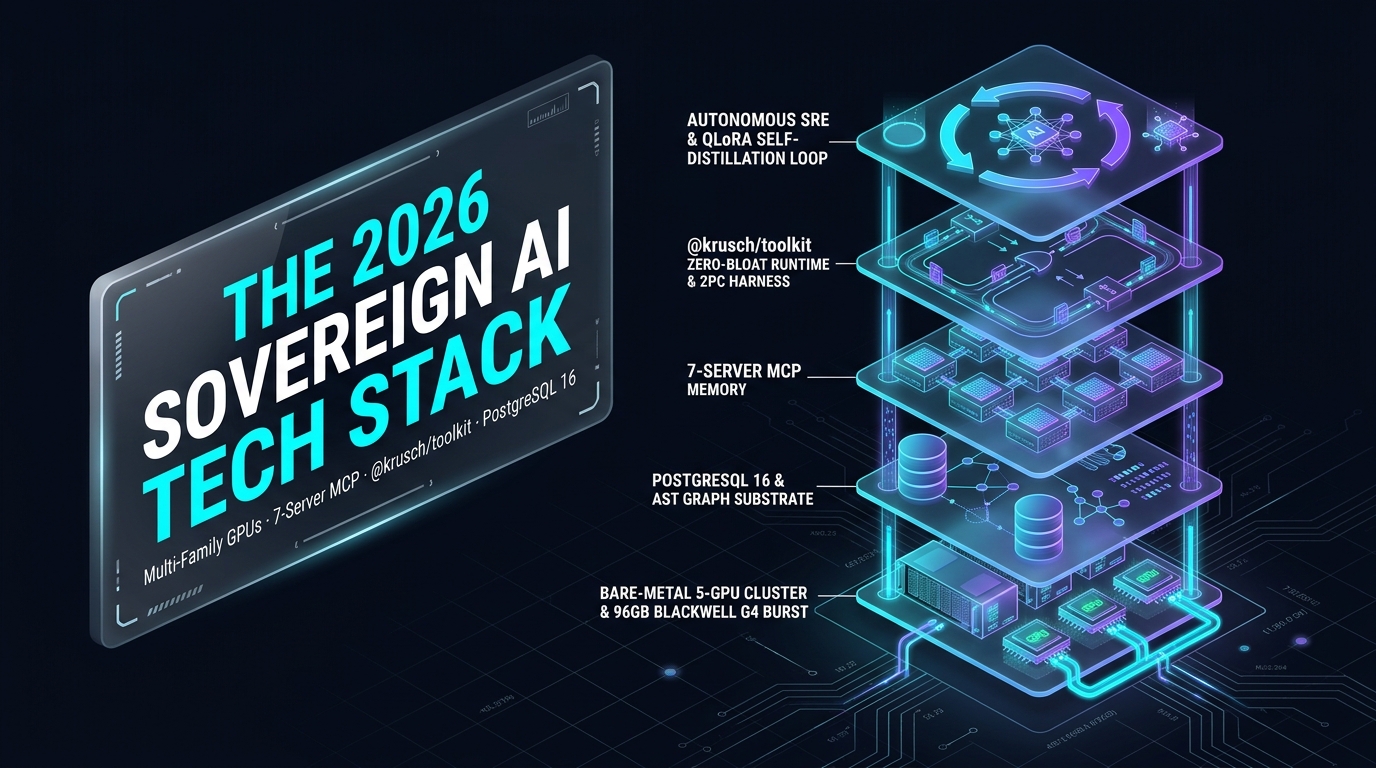
The 2026 Sovereign Tech Stack, Cross-Stack Benchmarks, Closed-Loop Audit & Operating Planes
End-to-end 5-GPU + 96GB Blackwell G4 stack blueprint, 15/15 production agentic systems matrix, cross-stack benchmark comparison evaluated across 335,000+ traces and 14 external suites (with published SHA-256 audit logs: 49 HF logs / 64 files & 95/95 clean-room gates, plus honest frontier gaps), 3-Tier MCP code audit & Wave-4/6 QLoRA+DPO distillation, krusch-stack v1.1 unified distribution, sub-15µs CPU cascade routing, and PostgreSQL state planes.
The 2026 Sovereign AI Tech Stack: Multi-Family GPUs, 3-Tier MCP Substrates, @krusch/toolkit, and Closed-Loop Distillation
Complete end-to-end engineering blueprint of the KruschDev tech stack: one-command unified distribution (krusch-stack v1.1 --defer-tools cutting schema bytes by 68.5% + Turn-0 Grounded v0.3 & <32ms 2PC Action/File Harnesses with POSIX atomic renameSync/fsync), 39-brick @krusch/toolkit v1.8.1 (141/141 Node, 16 Slop-Breaker detectors, 104/104 compliance), 5 bare-metal GPUs + 8K snowflake-arctic-embed2 + 96GB Blackwell G4 burst, evaluated across 335,000+ traces and 14 external suites (with published SHA-256 audit logs & 95/95 clean-room gates: BEAM, Snap LoCoMo [90.26% / 1,390/1,540 argon_matched & 95.77% dia_id recall, 89.68% argon_tight @ 4,465 mean tokens, 92.66% LoCoMo Oracle@2], DolphinBench 600 across 28 runs / 16,800 traces [98.33% Oracle@28: 91.17% (547/600 @ $24.54, Gemini 4 Argon Low, uploaded dolphinbench.ai submission UUID c047b063, queued awaiting leaderboard acceptance; exceeds current 70.67% published entry), 90.67% (544/600 @ $30.54, Argon Low + Grounded v0.3, 90.50% / 181/200 on Riley — self-run clean-room evaluation), 81.50% Luna + Grounded @ $1.35, and 57.33% (344/600 @ $0.00, Wave-6 krush420/gemma4-31b-sre-lora + Grounded — top open-weights score in self-run 28-run evaluation; 56.67% Stock + Grounded; 54.17% queued stock upload UUID 288671ad)], 90.0% DABstep @ $0.81 [2.54x faster], top ACL 2026 LLMRouterBench & Martian RouterBench, 0.7263 RouterArena, 1,046-episode AgentDojo 0.00% ASR, ACL 2025 CoIR, BIRD-SQL, BFCL v3, RepoBench-R, Aider Polyglot, LegalBench-RAG), and 4/4 Wave-4/6 31B/120B/30B/8B QLoRA+DPO adapters across 18,131 SFT+DPO rows.
The 15 Production Agentic Systems: Reference Architecture, State-Machine Invariants, and Benchmark Proofs Across a Sovereign Stack
Three engineering teardowns mapping all 15 production agentic pillars across krusch-stack, krusch-agentic-proxy, and krusch-coding-harness: asyncio.Semaphore(128) orchestrators + circuit breakers, strict 3-bucket token budgeting, Pydantic v2 error-trace retry routers, frozen typed swarms, 72h HMAC-SHA256 Slack HITL leases, 100-trajectory Golden DAG CI gates, 0.00% AgentDojo ASR (1,046 episodes) inter-agent sanitization, bwrap --unshare-net sandboxes, <32ms 2PC journals + POSIX atomic renameSync/fsync, $0.50 cost kill-switches, REST-to-browser fallback, and 5% non-blocking shadow diffing.
How an Open-Weights Sovereign Stack Stacks Up Across 335,000+ Benchmark Queries (Including Where Cloud Still Wins)
Concise head-to-head comparison of krusch-stack against open-source wrapper stacks and commercial cloud stacks across 14 external suites—evaluated across 335,000+ traces (with published SHA-256 audit logs: 49 HF logs / 64 files & 95/95 clean-room gates): DolphinBench (600 tasks, 28 runs / 16,800 traces [8 queued uploads on dolphinbench.ai + 20 clean-room self-run controls = 28/28 SHA-256-audited], 91.17% [547/600 @ $24.54, Gemini 4 Argon Low, uploaded dolphinbench.ai submission UUID c047b063, queued awaiting leaderboard acceptance; exceeds current 70.67% published entry], 90.67% [544/600 @ $30.54, Gemini 4 Argon (Low) + Grounded Harness v0.3, 90.50% / 181/200 on Riley — self-run clean-room evaluation], 81.50% GPT 5.6 Luna + Grounded @ $1.35 [71.1x cheaper than published Mem0; 81.33% queued upload], 98.33% [590/600] Global Oracle@28, 94.67% [568/600] Argon Low Oracle@2, 96.83% [581/600] Argon Oracle@4, 83.17% $0.00 Oracle@17, 71.83% Gemma 4 Oracle@6, & 57.33% [344/600 @ $0.00, Wave-6 krush420/gemma4-31b-sre-lora + Grounded — top open-weights score in self-run 28-run evaluation; 56.67% Stock + Grounded; 54.17% queued stock upload UUID 288671ad, outscoring 8 published cloud entries]), Snap LoCoMo (ACL 2024, 1,540/1,540 Category 1–4 QA probes, $0.00 zero-LLM ingestion: 90.26% [1,390/1,540] argon_matched accuracy & 95.77% dia_id recall, 89.68% argon_tight @ 4,465 mean tokens, 92.66% LoCoMo Oracle@2), Adyen DABstep (90.0% [9/10] @ $0.81, -74.5% cost, 2.54x faster; 40.0% vs. 20.0% Gemma 4 31B @ $0.00), RouterArena (0.7263 across 8,400 live queries, 74.44% @ $0.3802/1K, 91.43% rob., PR #169 open), ACL 2026 LLMRouterBench (#1 Pareto 0.4269), Martian RouterBench (#1 ID 0.7488/0.7695 & #1 OOD 0.7268/0.7455 across 72,980 rows), ETH SpyLab AgentDojo v1.2.2 (19.28% → 0.00% ASR across 1,046 episodes), ACL 2025 CoIR (56.40% #1 NDCG@10 across 2.39M docs & 162,216 Qs), BIRD-SQL Mini-Dev (26.00% → 40.20% EX), BFCL v3 Live (66.28% Micro, -80.67% schema tokens), ICLR 2026 BEAM (100K–10M), RepoBench-R, LegalBench-RAG, and Aider Polyglot (19.56% → 51.56%)—with explicit disclosures on reader ceilings, referee rubrics, and open PRs.
🧠 The Closed-Loop Audit & Distillation Pipeline: 3-Tier MCP Context Hydration, Cross-Family Referees, and Dual-Track QLoRA
How Jean SRE swept 88 repositories (Oct 2026 snapshot; 104 today) across 11 checkpoints: pre-hydrating AST caller/callee graphs and working-memory invariants via 3-Tier MCPs, eliminating false positives via Phase 1.9 Adversarial Steel-Manning, enforcing a Dual-Zero-Finding Cross-Family Referee gate, and fine-tuning 4/4 @krush420 open-weights QLoRA+DPO adapters (Wave-6 krush420/gemma4-31b-sre-lora + Grounded at 57.33% [344/600 @ $0.00 — top open-weights score in self-run 28-run DolphinBench evaluation; 54.17% queued stock upload UUID 288671ad], 120B Teacher [native Blackwell MXFP4], 30B Student, and 8B Edge) on 18,131 test-verified, rejection-sampled trajectories.
Multi-Tier Cascade Routing Architecture: Slashing Enterprise Inference Budgets by 60–80%
Stage-0 syntactic CPU gating (<15µs, $0.00 tax), 8K Arctic centroid escalation, and live SSE logprob abort. Validated top Pareto (0.4269, -83.95% cost) on ACL 2026 LLMRouterBench, top ID & OOD AIQ across 72,980 Martian RouterBench rows (-72.63% @ 98% GPT-4), 0.7263 on RouteWorks RouterArena (74.44% @ $0.3802/1K, 91.43% rob., PR #169 open), and -48.0% TTFT live SSE cascade.
Postgres as the State Plane: Why Side Effects Require a Transaction Manager
Why autonomous agents made me write more raw SQL, not less: 0 JS ORMs across 48 repos, 252ms → 15.25ms oversampled HNSW+GIN CTEs in krusch-git, 10M-token memory in krusch-context-mcp, and 2.64x Aider Polyglot 2PC self-healing in krusch-coding-harness.
3-Tier MCP Ecosystem: Governed Memory, Closed-System BEAM Benchmarks & AST/FS Graphs
Replacing flat sliding-window RAG with ACID decision lineage, 28-run DolphinBench 600-task evaluation (16,800 traces across 6 model families: 8 queued uploads on dolphinbench.ai + 20 clean-room self-run controls = 28/28 SHA-256-audited; 17 $0.00 open-weights + 11 frontier/model-matched runs), Snap LoCoMo (ACL 2024, 1,540/1,540 QA probes: 90.26% accuracy & 95.77% dia_id recall @ $0.00 ingestion) & zero-leakage closed-system ICLR 2026 BEAM evaluation, relational AST caller/callee graphs, and SHA-256 page-indexed OS filesystems.
Return on Memory: Why Test-Time Reasoning Unlocks Zero-Distillation Agentic Retrieval on Official DolphinBench (91.17%, #1 Overall)
Holding 13,539 episodic sessions byte-for-byte constant inside frozen 0o444 SQLite checkpoints ($0.00 Zero-LLM Raw-RAG + 4-Way RRF; uploaded submission UUID c047b063 queued on dolphinbench.ai awaiting leaderboard acceptance) across my compiled 19-run (11,400-trace) gpt-5.6-sol arXiv preprint, Gemini 4 Argon (Low) reaches 91.17% (547/600 @ $24.54, uploaded dolphinbench.ai submission UUID c047b063, queued awaiting leaderboard acceptance; exceeds current 70.67% published entry; 97.00% Oracle@19), model-matched GPT 5.6 Luna (High) hits 81.33% (488/600 @ $1.35, queued upload)—exceeding published Luna + Mem0 (70.67% @ $96.21) at 71.1x lower cost—and Gemma 4 31B Stock hits 54.17% @ $0.00 (queued upload UUID 288671ad). Expanded across 28 runs / 16,800 traces (8 queued uploads on dolphinbench.ai + 20 clean-room self-run controls) to 98.33% (590/600) Global Oracle@28, 90.67% (544/600 @ $30.54, Gemini 4 Argon (Low) + Grounded Harness v0.3, 90.50% [181/200] on Riley — self-run clean-room evaluation; 94.67% Argon Low Oracle@2, 96.83% Argon Oracle@4), 83.17% $0.00 Oracle@17, 71.83% Gemma 4 Oracle@6, 81.50% Luna + Grounded @ $1.35, and 57.33% (344/600 @ $0.00, Wave-6 krush420/gemma4-31b-sre-lora + Grounded — top open-weights score in self-run 28-run evaluation [56.67% Stock + Grounded]; 54.17% queued stock upload UUID 288671ad).
What 5,535 DolphinBench Runs Taught Me About Local AI Memory
Controlled multi-family study across 28 DolphinBench 600-task runs (16,800 traces across 6 model families: 8 queued uploads on dolphinbench.ai + 20 clean-room self-run controls = 28/28 SHA-256-audited) + 15 counterfactuals (13,539 sessions / 1.50M tokens, 0o444 frozen SQLite WAL): 91.17% (547/600 @ $24.54, Gemini 4 Argon Low, uploaded dolphinbench.ai submission UUID c047b063, queued awaiting leaderboard acceptance; exceeds current 70.67% published entry) & 90.67% (544/600 @ $30.54, Gemini 4 Argon (Low) + Grounded Harness v0.3, 90.50% [181/200] on Riley — self-run clean-room evaluation; 98.33% [590/600] Global Oracle@28, 94.67% [568/600] Argon Low Oracle@2, 96.83% [581/600] Argon Oracle@4); Wave-6 QLoRA+DPO krush420/gemma4-31b-sre-lora + Grounded reaches 57.33% (344/600 @ $0.00 — top open-weights score in self-run 28-run evaluation; 54.17% queued stock upload UUID 288671ad; 71.83% Gemma 4 Oracle@6, 83.17% $0.00 Oracle@17; +3.17 pp over 54.17% Stock & +0.67 pp over 56.67% [340/600] Stock + Grounded, +22.00 pp over matched-scale Qwen2.5-Coder-32B 35.33%, outscoring 8 published cloud entries); 4/4 @krush420 QLoRA+DPO adapters lift local Qwen3-Coder-30B-A3B to 43.00% + Grounded (42.67% Std., 61.17% Oracle@5), 120B to 39.50%, and 8B Q4_0 15.7x (18.33%); the unmodified $0.00 Zero-LLM SQLite store scores 90.26% (1,390/1,540, 95.77% dia_id recall, 89.68% argon_tight @ 4,465 mean tokens, 92.66% LoCoMo Oracle@2) on Snap LoCoMo (ACL 2024); and krusch-stack's generalized 2PC Action Harness cuts duplicate MCP calls -95.2% (42 → 2) across all 600 local 30B tasks.
🔬 Benchmarking Agent Memory Without Cheating: Closed-System ICLR 2026 BEAM (100K–10M)
De-rigging 5 memory benchmark traps, calibrating 8K isotropic cosine geometry, and evaluating krusch-context-mcp (v1.9.0 & v2.0.0) across all 100 chats (~178.34M tokens) and 2,000/2,000 official BEAM probes on SQLite inside one 96GB Blackwell box: 92.58% 100K & 93.00% 10M IE recall, zero E2E drop to 1M, and beating cloud past.dev on CR (4/4) & 10M MSR.
🧠 Beyond Flat Vector RAG: What Makes krusch-context-mcp Special
Why flat vector RAG fails coding agents. Deep dive into the radical 5-verb discipline (retrieve, remember, revise, nudge, health), hierarchical episode rollups, 2-hop multi-session bridges, span-grounded provenance drift healing, and closed-system validation across all 2,000/2,000 Official ICLR 2026 BEAM questions (100K–10M, ~178.34M tokens, 93.00% 10M IE recall) plus Snap LoCoMo (ACL 2024, 1,540/1,540 Category 1–4 QA probes, $0.00 zero-LLM ingestion: 90.26% [1,390/1,540] argon_matched accuracy & 95.77% dia_id recall, 89.68% argon_tight @ 4,465 mean tokens, 92.66% LoCoMo Oracle@2).
🌳 krusch-git: Git DAG Indexing, Relational AST Symbols, and Hybrid Recency Search for AI Coding Agents
Why grep and flat vector RAG fail autonomous coding agents. Git DAG objects in PostgreSQL 16 + pgvector, multi-language AST lexing & live import-activity analysis, 15.25ms HNSW/GIN search, and 19.12% Macro Acc@1 (68.58% Acc@5) across 47,998 RepoBench-R queries.
🗂️ krusch-fs-mcp: OS Filesystem Page Memory, SHA-256 Drift Detection, and Multi-Node Fleet Indexing for AI Agents
Turning unstructured OS directories, PDFs, DOCX, systemd units, and /etc/fstab across an 8-node SSH fleet into layout-true page trees with SHA-256 drift-verified PageMemory annotations and secret-redacted .env indexing.
Architecting Code-Agent Retrieval & Memory: Beyond Naive Vector Search
Why sliding-window RAG fails on codebases. Single-store PostgreSQL 16 + pgvector HNSW, structural symbol extraction, SQL Reciprocal Rank Fusion (RRF), and empirical benchmarks (8.2ms P50).
Read Retrieval Architecture Paper →Sovereign Context & Working-Memory Architecture for Coding Agents
Decoupling Enterprise Access Gateways from the Sovereign Context Plane and Safe Execution Harness. Tool profile projection, stratified lambda-decay priors, and PostgreSQL 16 durability.
Read Enterprise MCP Hub Paper →2-Phase Commit Coding Harnesses, Swappable Storage & Voice-First Execution
Enforcing Bubblewrap container sandboxes, PostgreSQL 2PC apply journals (<32ms with POSIX atomic renameSync/fsync), Polygres Cloud sync, and sovereign personal assistant workflows.
Why Coding Agents Need Certified Lego Bricks, Not Prompted Boilerplate: Inside a 35-Brick, Self-Evolving Code Substrate
How I eliminated LLM-regenerated HTTP 413 TCP ECONNRESET races, DNS-rebinding SSRF, SQLite lock quarantine, and YAML alias bombs across 100 repositories (3,150+ files, expanded in @krusch/toolkit v1.8.1 & krusch_toolkit v1.6.0 to 39 dual-runtime bricks + 16 Slop-Breaker detectors across 104/104 repos): 7 zero-LLM blueprints, a comment/string-masked MCP pre-commit guard, an autonomous Rule-of-3 anti-bloat scout (8/8 clusters promoted), and 2-stage QLoRA + DPO calibration lifting zero-tool brick accuracy from 25.0% → 100.0%.
🛡️ The Krusch Coding Harness: Why Autonomous Code Agents Require a Transaction Manager, Not a Prompt
Why unconstrained file writing breaks coding agents. Pre-commit SHA-256 diff staging, Bubblewrap isolation, verify-on-stop outer loops, and <32ms PostgreSQL 2PC apply journals with POSIX atomic renameSync/fsync file commits—lifting open-weights gpt-oss:120b from 19.56% → 51.56% (72 tasks self-healed) across 225/225 Aider Polyglot tasks.
💾 Swappable Substrates: Powering Agent Memory & Codebase Graphs with KruschContext, KruschGit, and Polygres
How swappable storage drivers let AI coding agents run on local zero-Docker SQLite/PostgreSQL or sync seamlessly with Polygres Cloud without changing a single MCP tool definition.
Read Swappable Substrates Paper →🚀 Local-First Core, Hybrid Cloud Elasticity: Decoupling Agent Memory
A practitioner's analysis of coding-agent memory topologies: SQLite edge caching (validated at 90.26% [1,390/1,540] argon_matched accuracy & 95.77% dia_id recall [89.68% argon_tight @ 4,465 mean tokens, 92.66% LoCoMo Oracle@2] across Snap LoCoMo's 1,540/1,540 ACL 2024 QA probes at $0.00 zero-LLM ingestion), PostgreSQL durability, embedding parity pitfalls, and two-stage HNSW decay indexing.
🛡️ Introducing Krusch Companion: A Sovereign, Voice-First Personal AI Assistant & Dual-Axis Daily Execution Engine
Complete guide to krusch-companion: Voice-to-Text capture, how the Dual-Axis Priority Board solves the Priority Paradox, the <holodata> agentic proxy, and a 10-minute daily efficiency playbook.
☁️ Introducing G-Krusch: A Sovereign Google Workspace Hub, Hybrid Drive RAG & MCP Bridge
Complete architectural deep dive into G-Krusch: cloud-synced agent.md steering, 3-tier 1,024-dim semantic + SQLite FTS5 BM25 Drive RAG, 3-tier PDF extraction, 12 MCP tools, and NIST AES-256-GCM security hardening.
Layout-True OCR Coordinates, Statutory Precedence DAGs & Contract Compliance
100% air-gapped document ingestion (KruschNexus), 0.00% False Support Rate golden-set statutory grounding (KruschLaw), and relational contract-vs-statute join engines (KruschBiz).
⚖️ The Sovereign Triad: Unifying Document Ingestion, Statutory Graphs, and Agentic Working Memory
How KruschNexus (layout-true ingestion), KruschLaw (statutory authority & assertion grounding), KruschBiz (contract graphs), and KruschContext MCP create a closed-loop, self-auditing intelligence substrate.
Read Sovereign Triad Architecture Essay →⚖️ Citations Die in Local RAG: Why I Built KruschNexus and What It's For
Why arbitrary token slicing destroys document citations. Heldout evaluation of 7 parser families (100% citation accuracy), contextual section-path embeddings + local mxbai-rerank-large-v2 cross-encoder reranking achieving 26.74% Macro F1 (k=1), 25.81% F1 / 44.72% Recall (k=2), and 47.71% Recall (k=6) across 6,889 LegalBench-RAG queries.
⚖️ Why I Built KruschLaw: Sovereign Legal Intelligence, Two-Pass Grounding & Statutory Precedence
Why generalist RAG fails in statutory law and municipal codes. Two-pass assertion grounding achieving a golden-set 0.00% False Support Rate on held-out statutory benchmarks, versioned statutory precedence graphs, and verifiable purge.
Read KruschLaw Architecture Deep Dive →💼 Why Semantic Similarity Isn't Governing Precedence: What Makes KruschBiz Different From Generic Business RAG
Why flat vector search fails on commercial contracts. Confirmed-edge precedence graph resolver, unexecuted draft isolation, materialized effective slots, and The Join compliance engine.
Read KruschBiz Architecture Deep Dive →📦 Authority Packs: Versioned Rulebooks for Enterprise AI — Sovereign Domain Scoping vs. Vector Bleed
Why enterprise buyers don't buy retrieval. How bounded, versioned rulebooks enforce O(1) token budgets, pre-extracted numeric slots, and physical citation truth across law, finance, and enterprise contracts.
Read Authority Packs Whitepaper →The Ingestion Imperative: Why Retrieval Quality Is Bounded Before the Model Reads a Single Word
Why wrong retrieval is the dominant root cause of enterprise AI failure. Deep dive into embedding space geometry, parser contracts, citation spines, and how the structured fix itself fails.
Read Systems Architecture Note →