
Kevin Ruschman
I build the reliability infrastructure that makes autonomous AI systems safe, persistent, and useful. Inside my independent bare-metal R&D lab (@kruschdev), I engineer open-source persistent memory substrates, pre-audited runtime bricks, and deterministic agent control planes—where language models generate candidate actions while deterministic software gates (PostgreSQL 16 write-ahead state, Bubblewrap sandboxes, AST dependency graphs, and a <15µs pure-CPU Stage-0 syntactic gate prior to model inference) govern what actually executes.
Lab Provenance: Independent engineering research and open-source development. Projects and reference architectures are developed and tested in my own lab unless otherwise indicated.
Target Engineering Roles: Seeking engineering roles on teams building agent infrastructure, persistent memory, model orchestration, sandboxed code execution, or AI reliability and evaluation. Open to senior-level and higher-scope technical roles, depending on team needs and responsibilities (Los Angeles, CA · Hybrid · Remote).
Three flagship projects, one headline result each (all self-run in my lab; benchmark evidence & status →):
- krusch-context-mcp (agent memory):
90.26%accuracy and95.77%evidence recall on the public ACL 2024 SnapLoCoMobenchmark (1,540 questions), with $0 LLM cost for memory ingestion. - @krusch/toolkit (code verification):
16deterministic static/AST detectors that flag known security and boilerplate defects in AI-written code in under 1ms, without another LLM. - krusch-coding-harness (safe execution): a journaled, crash-recoverable multi-file apply protocol (PostgreSQL write-ahead intent + POSIX atomic per-file replacement);
116/116tests pass, including a SIGKILL mid-apply recovery test.
Core Open-Source Infrastructure: Agent Memory, Code Verification & Crash-Recoverable Execution
Three complementary open-source substrates addressing the primary reliability failure modes of autonomous coding agents: krusch-context-mcp governs the reliability of an agent's persistent memory and architectural invariants, while @krusch/toolkit and krusch-coding-harness govern the reliability and safety of the code and side effects it produces.
krusch-context-mcp — Zero-LLM Episodic Memory & SHA-256 Drift-Guarded Invariants
- Problem:
- Long-horizon coding agents lose architectural invariants across sessions, retrieve stale or contradictory context, or burn LLM tokens on lossy summarization.
- Architecture:
- Deterministic
$0.00zero-LLM256/32-tokenRaw-RAG+ local1024dsnowflake-arctic-embed2+ SQLite Porter-FTS5 4-Way Reciprocal Rank Fusion +INV-12SHA-256 line-span drift detection + 2-hop Gram-Schmidt residual bridge. - Implementation:
- Node.js 22
node:sqliteWAL (0o444read-only benchmark stores, optionalPostgreSQL 16 + pgvectorbackend) exposing 5 canonical MCP verbs (retrieve,remember,revise,nudge,healthin~350schema tokens). - Verification:
144/144automated Node tests +5/5BlindMappingGuard(LoCoMo) &10/10BEAMSHA-256 zero-leakage verifiers + cross-familyT=0evaluation judges.- Results:
90.26%accuracy &95.77%dia_idrecall across1,540ACL 2024 SnapLoCoMoprobes at$0.00ingest;91.17%(547/600@$24.54) uploadeddolphinbench.aisubmission (UUID c047b063, queued awaiting leaderboard acceptance; exceeds current70.67%published entry); self-run 600-task evaluations with published audit logs at90.67%(544/600+ Grounded v0.3,90.50%onRiley),81.50%@$1.35(71.1xcheaper thanMem0on identicalGPT 5.6 Luna),57.33%(344/600Wave-6Gemma 4 31B@$0.00, top open-weights self-run result;54.17%queued stockUUID 288671ad), and98.33%Oracle@28;2,000/2,000ICLR 2026BEAMup to10Mtokens (93.00%IE).- Limitations:
- Zero-LLM
Raw-RAGmisses1.67%(10/600) of tasks requiring implicit multi-turn synthesis with zero lexical or dense-vector overlap; localnode:sqliteWAL targets single-host agent sessions rather than distributed multi-writer clusters (addressed via thePostgreSQL 16adapter).
@krusch/toolkit & krusch_toolkit — Pre-Audited Runtime Bricks & Sub-Millisecond Slop-Breaker
- Problem:
- Coding agents repeatedly generate subtly broken boilerplate—DNS-rebinding SSRF regexes, non-constant-time webhook checks, unclamped ORM pagination, hardcoded JWT fallbacks, and un-aborted fetches.
- Architecture:
- Pre-audited runtime "Lego bricks" (
39modules,64.d.tssubpaths,7blueprints) paired with a deterministic<1mscomment/string-masked static & structuralauditBoilerplateTextSlop-Breaker gate (16rules)—deliberately using zero-cost deterministic static analysis instead of slow, probabilistic LLM linting. - Implementation:
- Node 22 ESM & Python 3.12 libraries providing connect-time DNS-pinned
safeFetch,timingSafeEqualHMAC verification,409/422idempotency locks, SHA-256 hash-chained audit logs, zero-node:*RBAC/IDOR guards, and<15µs(<25µsceiling) pure-CPU Stage-0 cascade circuit breakers. - Verification:
141/141Node tests +201/201pytesttests +0/212release-hygiene checks + live third-party OSS validation onOWASP/NodeGoat,node-express-realworld-example-app, andstripe-samples/accept-a-payment(104/104clean compliance across internal repos).- Results:
- Catches real SSRF, auth-secret fallback, unclamped pagination, and unsafe YAML/webhook anti-patterns in
<1msat$0.00compute cost; paired Okapi BM25 deferred MCP loading (krusch-stack v1.1) cuts upfront tool-schema bytes-68.5%(+6.40 ppBFCL v3accuracy). - Limitations:
- Structural/AST rules target deterministic vulnerability and boilerplate classes (
16rules), not arbitrary domain-logic bugs; dynamicevalor cross-service taint requires sandboxed runtime tests and multi-family code review (runThreeFamilyRefereeAudit).
krusch-coding-harness & krusch-grounded-harness — Write-Ahead Apply Journals & Turn-0 Grounding
- Problem:
- Unconstrained coding agents overwrite dirty working trees, spin in duplicate failing tool calls, execute prompt-injected shell commands, or leave partial file writes on mid-commit crash.
- Architecture:
- Import-frozen
Object.freezepolicy floors + Bubblewrap (bwrap) sandboxes +<150msTurn-0 schema/hazard grounding +PostgreSQL 16write-ahead apply journaling paired with pre-commit SHA-256 file-drift guards, POSIX atomicrenameSync/fsyncreplacement, and startup crash reconciliation. - Implementation:
- Deterministic state machine (
PENDING → VERIFYING → APPROVED → APPLYING → APPLIED / RECOVERED) with deterministic mid-apply crash-injection hooks (SIGKILL after the first rename viaKRUSCH_TEST_HOOK_PAUSE_AFTER_FIRST_RENAME, thenrecoverInFlightApplies()), comment-normalized spin-loop memoization (INV-GH-04), and0-turn defect-only output gates (INV-GH-06). - Verification:
116/116krusch-coding-harnesstests (including interrupted-apply crash recovery & reconciliation) +7/7krusch-grounded-harnesstests +1,046ETH SpyLabAgentDojosecurity episodes +225Aider Polyglotexercises +120adyen/DABstepepisodes.- Results:
0.00%Attack Success Rate (0/1,046AgentDojoprompt-injection episodes),<32mslocal write-ahead journal + atomic swap overhead,51.56%Aider Polyglot(2.64xlift on open-weights),90.0%DABstep@$0.81(-74.5%cost,2.54xfaster), and-95.2%(42 → 2) duplicate MCP calls.- Limitations:
- Terminology: "2PC" is this project's name for a journaled, crash-recoverable multi-file apply protocol (PostgreSQL write-ahead intent + POSIX atomic per-file replacement), not classic distributed two-phase commit with transactional participants. Each file swap is atomic, but a multi-file batch is not atomically visible: another process can observe a partly-applied batch until it completes or recovery rolls it back.
PostgreSQLACID does not natively span POSIX filesystems—write-ahead journaling +renameSync+ startup reconciliation recovers mid-commit process crashes, but an uncoordinated external OS process mutating the same file in the sub-millisecond window between the SHA-256 pre-check andrenameSynccan still race without container/worktree isolation.
krusch-coding-harness code against PostgreSQL — applyDiffBatch() is killed with SIGKILL right after the first file rename, leaving a torn state, and recoverInFlightApplies() restores both files and resets the rows to PENDING. Source: scripts/demo-crash-recovery.mjs (same path as test/integration/crash-smoke.test.js) · raw output.Interactive Trace: Persistent Memory, Static Gates & Crash-Recoverable 2PC
Step through a multi-session task to inspect how krusch-context-mcp, @krusch/toolkit, and krusch-coding-harness block stale line drift, catch SSRF boilerplate in <1ms, and recover cleanly from a mid-commit crash. Illustrative replay: function, table, and outcome names match the source; the recording above is the real run.
Session 1 records an architectural invariant anchored to exact file coordinates (src/public/assets/layman-mode.js#L21) with a SHA-256 line-span hash at $0.00 zero-LLM cost.
krusch_context_remember({
  category: "invariant",
  content: "Keep STORAGE_KEY pinned at line 21",
  provenance: { file: "src/public/assets/layman-mode.js", start_line: 21 }
}){
"ok": true,
"id": 152,
"anchor": "layman-mode.js#L21",
"sha256": "a4f9c2e8...81c2",
"status": "VALID",
"ingest_cost_usd": 0
}From Physical Operations & Field Diagnostics to Deterministic Agent Infrastructure
Before focusing full-time on AI infrastructure, I spent nine years (2014–2023) working in physical environments where symptoms rarely match root causes and mistakes carry immediate operational cost—executing electrical panel modifications, conduit runs, power budgeting, grounding, and structural carpentry in Southern Vermont; directing mobile field-diagnostic crews and logistics for the Wisconsin Bicycle Federation; and launching and operating a physical cafe in Aspen, Colorado from buildout through supply chain, POS systems, and staff training to first-year profitability (building on earlier leadership as an Eagle Scout directing a 9-person crew).
That background directly shaped how I architect AI systems today. In electrical and field engineering, you never trust an ungrounded load or assume the happy path holds under load—you install circuit breakers, isolate fault domains, and verify state with instruments before energizing a line. I treat language models the exact same way: use deterministic software (PostgreSQL write-ahead state, <15µs pure-CPU gates, <1ms static AST checks, and POSIX atomic renameSync journals) wherever conventional engineering solves the problem cleanly, and reserve probabilistic models strictly for bounded reasoning inside verifiable sandboxes.
The Lab Behind the Three Projects
The flagship projects run on infrastructure I assembled and operate myself. This is the supporting layer, not the headline: one diagram, one table, and the full details folded below.
What leaves the lab (scope: the lab workflows documented on this site — benchmark runs, code-review audits, publishing): external services receive only public benchmark data and my own open-source code. No private or third-party customer data is used in these workflows. Projects that support optional frontier-model escalation (for example the cascade router) send prompts to that provider when escalation is enabled; the offline-capable reference designs run with it turned off.
| Layer | Role | Main pieces |
|---|---|---|
| 1 · Routing | Pick the cheapest model that can do the job | <15µs CPU pre-gate, cascade router, local GPU pool + optional cloud burst |
| 2 · Memory & code knowledge | What the agent knows across sessions | krusch-context-mcp (decisions, invariants), krusch-git (code graphs), krusch-fs (OS files) |
| 3 · Safe execution | What the agent is allowed to change | krusch-coding-harness: sandbox, tests, write-ahead journal, crash recovery |
| 4 · Data | Durable state and search | PostgreSQL 16 + pgvector, SQLite for single-machine memory |
| 5 · Feedback loop | Improve from verified outcomes | @krusch/toolkit bricks, maintenance daemon, fine-tuned open-weights adapters |
Research Experiments prototypes, not products
- KruschNexus — offline PDF reading with page-and-line citations
- KruschLaw — statute lookup with point-in-time rule versions
- KruschBiz — contract amendment and precedence tracking
Show full architecture details (5-layer blueprint, hardware topology, change lifecycle)
The 2026 Sovereign AI Tech Stack: Multi-Family GPUs, 3-Tier MCP Substrates, @krusch/toolkit & Closed-Loop Distillation
Why I inverted the conventional cloud-wrapper AI stack—treating language models as stateless compute samplers governed by bare-metal multi-family GPUs, relational PostgreSQL 16 write-ahead state planes, a zero-bloat shared monorepo toolkit, and autonomous QLoRA self-distillation:
- Unified 1-Command Installer (
krusch-stack): Runnpx krusch-stack init --defer-toolsordocker compose up -d(v1.1.0) to wire all 7 pillars, 39 annotated MCP tools via Okapi BM25 deferred schema loading (-68.5%upfront schema bytes), my Turn-0 Grounded Harness (v0.3), and my generalized2PCTool-Action Harness (INV-STACK-10) across Claude Code, Cursor, Windsurf, and Antigravity. - Pillar I · Multi-Family 5-GPU, 8K Arctic & 96GB G4 Burst:
Qwen3-30B-MoE(124.2 tok/s) audited by orthogonalGemma 4&Hermes 3Referees to eliminate single-family blind spots, paired with local8Ksnowflake-arctic-embed2embeddings and on-demand 96GB Blackwell G4 burst compute (gpt-oss:120b&gemma4:31b). - Pillar II · Orthogonal 3-Tier MCP & Precedence Substrates: Strictly separates episodic working memory and invariant lineage (
krusch-context-mcp), relational Git DAG & AST caller/callee graphs (krusch-git), 8-node SSH OS page trees (krusch-fs-mcp), write-ahead 2PC diff staging (krusch-coding-harness), and layout-true legal/contract precedence engines (KruschNexus,KruschLaw,KruschBiz). - Pillar III–V ·
@krusch/toolkit, Raw-RAG, Jean SRE & QLoRA Flywheel: 39-brick Node 22 ESM (v1.8.1) & Python 3.12 (v1.6.0) substrates + 16<1msstatic Slop-Breaker rules power 24/7 Jean SRE sweeps across 104 repos—distilling 18,131 Zero-Leak SFT + DPO trajectories (sovereign-code-audit-sft) into published 31B Dense, 120B Teacher, 30B Student, and 8B Edge QLoRA+DPO adapters.
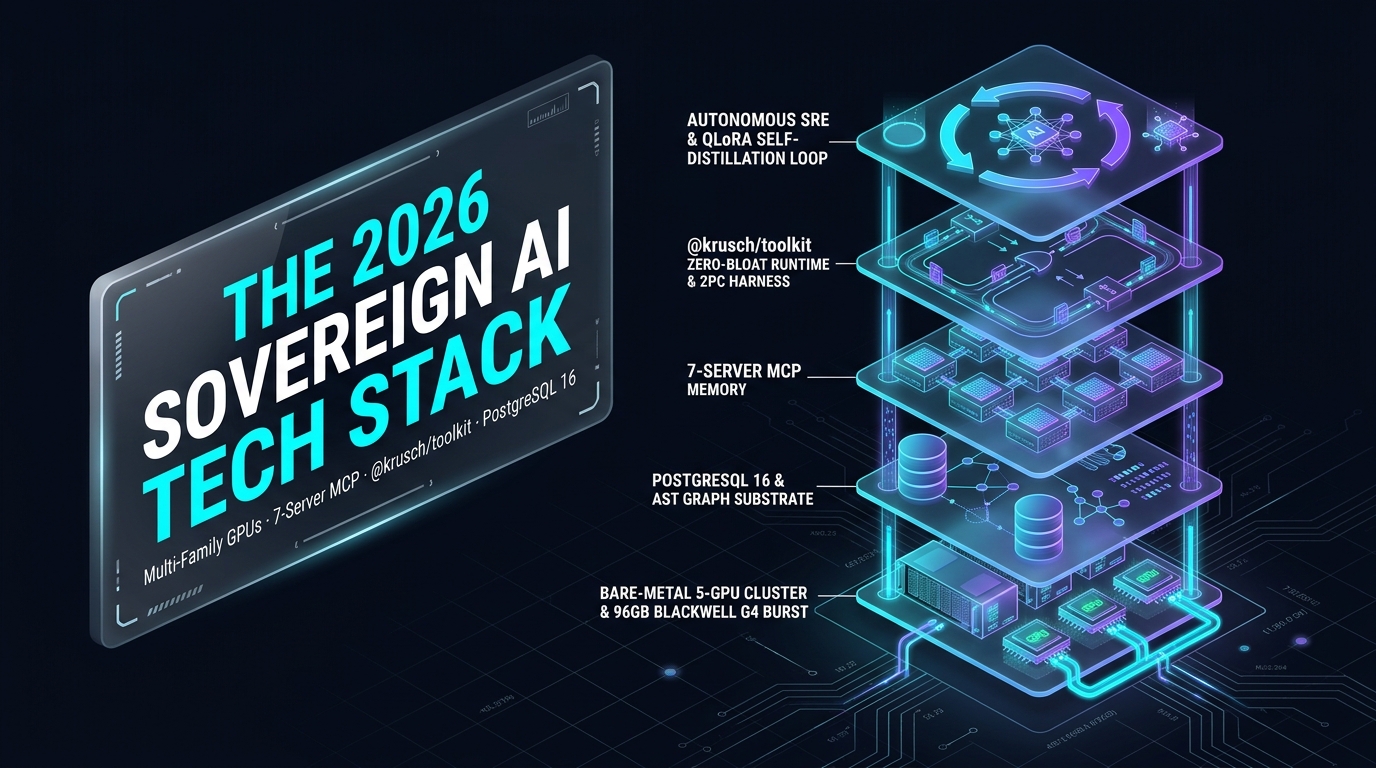
The 5-Layer Sovereign AI Tech Stack
How multi-family bare-metal GPU routing, 7-server MCP substrates, sandboxed 2PC harnesses, offline-capable document intelligence, and @krusch/toolkit + QLoRA self-distillation compose into a unified platform.
Microsecond Syntactic Gating, Neural Centroids & Multi-Family GPU Pooling
Eliminates the 500ms LLM "routing tax." Intercepts deterministic patterns in <15µs (<25µs ceiling) via an in-process pure-CPU Stage-0 syntactic/lexical gate prior to model inference for $0.00, routes semantic intents via 8K snowflake-arctic-embed2 centroids to a multi-family 5-GPU bare-metal pool (Qwen3-Coder-30B-MoE at 124.2 tok/s + Gemma 4 / Hermes 3 cross-family Referees), bursts on-demand to 96GB Blackwell G4 (gpt-oss:120b & gemma4:31b), and reserves frontier Gemini 4 Argon escalation strictly for tail reasoning and 3-viewport UI visual audits.
In-process pure-CPU Stage-0 syntactic/lexical classifier and exact-match LRU memoization table executed prior to model inference (<15µs typical, <25µs ceiling; <10µs exact-match hit). Intercepts code fences, SQL, stack traces, and voice board intents with zero token burn.
Dual-stage L1 pure-CPU Stage-0 syntactic/lexical gate (<15µs / <25µs ceiling prior to inference) + L2 1,024d Arctic centroid router with live SSE logprob/loop circuit breakers—dispatching each prompt to the lowest-cost capable tier before escalating (0.7263 CI-verified upstream submission on RouteWorks/RouterArena PR #169; full routing tables in whitepaper).
5 bare-metal GPUs across Dual RTX 3060 (24GB), Dual RTX 2080 Ti (22GB NVLink), and 11GB Orchestrator + on-demand 96GB Blackwell G4 burst (120B QLoRA distillation & 31B dense open-weights evals) and @krusch/toolkit runtime.
Governed Episodic Memory, Git DAG / AST Graphs & Multi-Node Fleet Page Trees
Replaces flat sliding-window RAG with three specialized Model Context Protocol substrates backed by PostgreSQL 16 + pgvector HNSW and zero-Docker SQLite WAL. Separates invariant working memory (krusch-context-mcp), Git DAG & AST caller/callee graphs (krusch-git), and OS/fleet filesystem page memory (krusch-fs-mcp).
5-verb sovereign coding-agent working memory (retrieve, remember, revise, nudge, health) in ~350 schema tokens. Pairs $0.00 zero-LLM 256/32-token Raw-RAG + 4-Way Reciprocal Rank Fusion with explicit decision superseding and INV-12 SHA-256 line-span drift detection so stale architectural rules never silently poison new sessions.
Relational Git DAG, multi-language AST chunker (JS/TS/Py/Go/Rust/Java) & live import-activity analyzer in PostgreSQL 16 (15.25ms HNSW/GIN)—tracing inbound callers and outbound callees before an agent modifies public interfaces across repositories.
OS filesystem & multi-node SSH fleet page memory powered by KruschNexus Library Mode. Indexes PDFs, DOCX, and /etc/systemd into compact float32 vector blobs & SHA-256 drift-verified page trees.
Write-Ahead Diff Staging, Policy Floors, Sandboxed Verification & Voice-First Daily Execution
Enforces hard deterministic boundaries between probabilistic model outputs and physical side effects. Code agents stage patches behind import-frozen policy floors and truncation breakers before committing via a PostgreSQL write-ahead apply journal paired with POSIX atomic renameSync/fsync replacement and pre-commit SHA-256 drift guards (<32ms local journal+swap overhead); personal and SRE agents operate under Confirm-Before-Act gates and inter-agent prompt sanitization.
PostgreSQL state-machine harness enforcing import-frozen policy floors, Turn-0 workspace schema/hazard grounding (krusch-grounded-harness v0.3), duplicate tool-call memoization, ephemeral Bubblewrap sandboxes, and crash-recoverable write-ahead apply journals paired with POSIX atomic renameSync/fsync replacement.
100% local-first personal AI assistant & daily execution PWA. Local faster-whisper voice dictation, Dual-Axis Priority Board, 20-tool <holodata> proxy, 256/32-tok Raw-RAG recall & Skylight sync.
Swappable storage substrate bridging local SQLite/PostgreSQL with Polygres Cloud (pgContext + pgGraph) and 40-char SHA pinning with fail-closed air-gap enforcement.
Physical Citation Coordinates, Statutory Preemption DAGs & Contract Compliance Joins
Replaces naive cosine similarity in regulated legal, financial, and commercial workflows with physical coordinate preservation (pdf_page, printed_page, bbox, char_start..end), versioned statutory precedence graphs, and confirmed-edge contract amendment resolution.
7-parser-family layout-aware ingestion spine pairing contextual section-path embeddings with a local mxbai-rerank-large-v2 cross-encoder—delivering exact page, bounding-box, and character coordinates to downstream legal and commercial engines without arbitrary token slicing.
Sovereign legal intelligence engine enforcing two-pass proposition entailment against source statutory text, bounded Authority Packs preventing cross-jurisdiction vector bleed, temporal as_of_date preemption DAGs (Floor vs. Ceiling rules), and cryptographic purge.
Confirmed-edge commercial contract graph resolving MSA/SOW/Amendment overrides, unexecuted draft isolation, and "The Join" (contract slot vs. statutory floor) via a <450-token 5-verb Gateway MCP.
Zero-Dependency Shared Toolkits, 24/7 Jean SRE & Self-Distilling SFT Flywheel
Eliminates transitive framework bloat across 28+ services via unified 39-brick zero-dependency Node.js 22 (v1.8.1) & Python 3.12 (v1.6) toolkits, an autonomous 24/7 SRE daemon auditing 104 repositories (Nov 2026) on bare metal, and a closed-loop QLoRA+DPO pipeline converting unit-test-verified remediations into open-weights adapters.
Unified Node.js 22 ESM & Python 3.12 foundations (39 release-gated bricks, 7 blueprints & 16 static Slop-Breaker rules) standardizing 8K snowflake-arctic-embed2 batching, zero-LLM 256/32-tok Raw-RAG, atomic idempotency, tamper-evident audit-log, zero-node:* rbac, HMAC pagination, and Cross-Family Referee gates.
Autonomous 3-Tier MCP SRE daemon sweeping 104 repositories (Nov 2026) across 11 checkpoints with pre-hydrated AST caller graphs, Phase 1.9 Adversarial Steel-Manning, and Cross-Family Referee convergence gates.
Distills unit-test-gated remediations and rejection-sampled trajectories (18,131 rows across 7 splits) through krusch-stack into published open-weights LoRA+DPO adapters (31B Dense, 120B Teacher in Blackwell 4-bit MXFP4, 30B Student, and 8B Edge) that feed directly back into local routing tiers.
Local-First Lab Infrastructure & Multi-Family GPU Plane
Self-hosted 8-node Linux fleet engineered for zero cloud telemetry leakage, dedicated 10GbE PostgreSQL/vector storage throughput, 100% GPU-resident multi-family inference, and on-demand 96GB Blackwell G4 cloud burst distillation.
Primary lab database & vector plane hosting PostgreSQL 16 + pgvector (dedicated NVMe relational & HNSW storage), DBOS durable execution, secondary 8K snowflake-arctic-embed2, and my non-Qwen Referee pool (gemma4:e4b + hermes3:latest).
High-throughput compute server pinning 100%-GPU Qwen3-Coder-30B-MoE (q8_0 KV cache) at 124.2 tok/s, autonomous 24/7 Jean SRE 104-target codebase sweeps, and hermetic container test verification with strict OS NVMe write protection.
Central orchestrator pinning 8K-ctx 1,024-dim snowflake-arctic-embed2 (89.17% R@1), qwen2.5-coder:7b (74.6 tok/s), and 16kHz faster-whisper ASR—plus on-demand 96GB RTX PRO 6000 Blackwell G4 burst running gpt-oss:120b (~117.7 tok/s) and Dual-Track QLoRA distillation.
.env secret redaction · Zero-Docker SQLite WAL fallback.
The Invariant Execution Lifecycle: Stage → Verify → Commit
How krusch and kd-Code prevent autonomous coding agents from corrupting git repositories or applying broken refactors.
The model plans and generates diffs directly into relational tables (staged_diffs). Zero unvetted file writes ever touch your physical working tree.
A shadow workspace runs automated test suites, typechecks, and linters in isolation. If a test fails, the staged turn aborts instantly without repo pollution.
Inspect side-by-side color-coded diffs via @pierre/diffs, caller/callee symbol graphs, and invariant nudges before authorizing disk modification.
Only on verified tests AND explicit human approval does a PostgreSQL write-ahead apply journal paired with POSIX atomic renameSync/fsync replacement and pre-commit SHA-256 drift guards swap changes onto disk (<32ms local journal+swap overhead) with 1-click rollback.
Benchmark Evidence & Publication Status
Every result on this site comes from a public benchmark dataset that I ran myself, with the raw logs published. Running a public benchmark is not the same as an outside party reproducing it or a leaderboard accepting it, so each result is labeled with exactly how far it has gone.
Self-Run Evaluations (Published Logs)
Most results. Public datasets, run in my lab, raw logs published: Snap LoCoMo 90.26% accuracy / 95.77% evidence recall (1,540 questions); DolphinBench 90.67% with Grounded v0.3 (544/600; 90.50% on the Riley slice); AgentDojo 0/1,046 successful prompt-injection attacks; Aider Polyglot 51.56%; DABstep 9/10 tasks (small sample).
Official Submissions Queued
DolphinBench 91.17% (547/600, Gemini 4 Argon Low, UUID c047b063) and 54.17% (325/600, stock Gemma 4 31B, UUID 288671ad) pass the official validator and are uploaded to dolphinbench.ai, but are not yet on the leaderboard. Until accepted, read them as self-run results.
RouterArena PR #169 (Open)
0.7263 across 8,400/8,400 live queries (74.44% accuracy at $0.38/1K). The project's own github-actions CI re-checked the submitted receipts; the pull request is open, not yet merged.
None Yet — Invitation Open
No outside party has re-run these results yet. Scripts, frozen read-only memory stores, and 49 raw log sets (64 files) are public on Hugging Face so anyone can check them; reproduction attempts are welcome as GitHub issues.
Core Architectural Invariants
The non-negotiable systems rules governing every layer in the KruschDev ecosystem.
Deterministic State Managers
Never trust language models to police their own file writes or follow conversational rules. Enforce constraints in PostgreSQL write-ahead state tables, AST dependency parsers, pre-commit SHA-256 drift guards, and POSIX atomic renameSync/fsync apply journals.
Multi-Tier Routing Cascades
Don't burn a 500ms LLM call just to choose an LLM. Intercept structured syntax in <15µs (<25µs ceiling) via an in-process pure-CPU Stage-0 syntactic/lexical gate prior to model inference for $0.00, escalate to sub-50ms neural centroids, and query frontier models only when necessary.
Offline-Capable Hardware Control
Run compute, vector indexes, and episodic memory on self-hosted bare-metal clusters. Offline-capable configurations keep privileged files and organizational memory within the self-hosted environment; cloud escalation, when enabled, sends the relevant prompts to the configured provider.
Technical Publications by Architectural Layer (26)
Reproducible architectural deep dives, empirical ablation benchmarks, and systems specifications.
The 2026 Sovereign Tech Stack, Cross-Stack Benchmarks, Closed-Loop Audit & Operating Planes
End-to-end stack architecture, 15/15 production agentic systems matrix, 335,000+-trace cross-stack benchmark comparison across 14 external suites (95/95 SHA-256 clean-room gates), 5-GPU + 96GB G4 burst compute, 3-Tier MCP code audits, Wave-4/6 QLoRA+DPO self-distillation, and <15µs (<25µs ceiling) in-process pure-CPU Stage-0 syntactic/lexical gates prior to model inference.
The 2026 Sovereign AI Tech Stack: Multi-Family GPUs, 3-Tier MCP Substrates, @krusch/toolkit & Closed-Loop Distillation
Complete end-to-end engineering blueprint of the KruschDev tech stack: 5 bare-metal GPUs + 8K snowflake-arctic-embed2 + 96GB Blackwell G4 burst, 8 MCP servers evaluated across 14 external benchmark suites (90.26% Snap LoCoMo [95.77% recall @ $0.00 ingest]; 91.17% DolphinBench uploaded submission UUID c047b063 queued awaiting leaderboard acceptance, plus self-run 600-task evaluations with published audit logs at 90.67% + Grounded v0.3 [90.50% on Riley] & 57.33% Wave-6 krush420/gemma4-31b-sre-lora @ $0.00 across 28 runs / 16,800 traces; 90.0% DABstep @ $0.81 [2.54x faster]; 2,000/2,000 BEAM; 0.7263 CI-verified RouterArena PR #169, ACL 2026 LLMRouterBench & Martian RouterBench; 47,998-Q RepoBench-R; 51.56% Aider Polyglot; 6,889-Q LegalBench-RAG), 39-brick @krusch/toolkit v1.8.1 (141/141 Node, 16 Slop-Breaker detectors, 104/104 compliance), krusch-stack v1.1 --defer-tools (-68.5% schema bytes) + Grounded v0.3 & 2PC Harnesses, and 4/4 Wave-4/6 31B/120B/30B/8B QLoRA+DPO adapters across 18,131 SFT+DPO rows.
The 15 Production Agentic Systems: Reference Architecture, State-Machine Invariants & Benchmark Proofs
Three architectural teardowns mapping all 15 production agentic engineering pillars across krusch-stack, krusch-agentic-proxy, and krusch-coding-harness: asyncio.Semaphore(128) orchestrators + circuit breakers, strict 3-bucket token budgeting, Pydantic v2 error-trace retry routers, frozen typed swarms, 72h HMAC-SHA256 Slack HITL leases, 100-trajectory Golden DAG CI gates, 0.00% ASR inter-agent sanitization (1,046-episode AgentDojo security suite), bwrap --unshare-net sandboxes, $0.50 cost kill-switches, REST-to-browser fallback, and 5% non-blocking shadow diffing.
How an Open-Weights Sovereign Stack Stacks Up Across 335,000+ Benchmark Queries (Including Where Cloud Still Wins)
Empirical cross-stack comparison of krusch-stack against open-source wrapper stacks and commercial cloud stacks across 14 external suites (95/95 SHA-256 clean-room gates): DolphinBench (91.17% [547/600 @ $24.54] uploaded dolphinbench.ai submission UUID c047b063 queued awaiting leaderboard acceptance; plus self-run 600-task evaluations with published audit logs across 28 runs / 16,800 traces at 90.67% Argon Low + Grounded v0.3 [90.50% on Riley], 81.50% Luna + Grounded @ $1.35 [71.1x cheaper than Mem0], 57.33% Wave-6 krush420/gemma4-31b-sre-lora @ $0.00 [54.17% queued stock UUID 288671ad], and 98.33% Global Oracle@28), ACL 2024 Snap LoCoMo (90.26% [1,390/1,540], 95.77% dia_id recall [181.8ms] @ $0.00 zero-LLM ingest), Adyen DABstep (90.0% @ $0.81, -74.5% cost, 2.54x faster; 40.0% Gemma 4 31B @ $0.00), RouterArena (0.7263 CI-verified upstream submission PR #169 across 8,400/8,400 live receipts), ACL 2026 LLMRouterBench (0.4269 Pareto), Martian RouterBench (72,980 rows), ETH SpyLab AgentDojo v1.2.2 (19.28% → 0.00% ASR across 1,046 episodes), ACL 2025 CoIR (56.40% NDCG@10 across 162,216 Qs), BIRD-SQL Mini-Dev (26.00% → 40.20% EX), BFCL v3 Live (66.28% Micro, -80.67% schema tokens), ICLR 2026 BEAM, RepoBench-R, LegalBench-RAG, and Aider Polyglot (19.56% → 51.56%)—with explicit reader-ceiling and methodology caveats.
🧠 The Closed-Loop Audit & Distillation Pipeline: 3-Tier MCP Context Hydration, Cross-Family Referees & Dual-Track QLoRA
How Jean SRE swept 88 repositories (Oct 2026 snapshot; 104 today) across 11 checkpoints: pre-hydrating AST caller/callee graphs and working-memory invariants via 3-Tier MCPs, eliminating false positives via Phase 1.9 Adversarial Steel-Manning, enforcing a Dual-Zero-Finding Cross-Family Referee gate, and fine-tuning 4/4 @krush420 open-weights QLoRA+DPO adapters (Wave-6 Gemma 4 31B top open-weights self-run result 57.33% + Grounded @ $0.00, 120B Teacher [native Blackwell MXFP4], 30B Student, and 8B Edge) on 18,131 test-verified SFT + DPO trajectories.
Multi-Tier Cascade Routing: Slashing Enterprise Inference Budgets by 60–80%
Systems architecture deep dive into krusch-cascade-router (0.7263 CI-verified upstream submission on RouteWorks RouterArena [PR #169, github-actions[bot] verified on 8,400/8,400 live receipts; 74.44% @ $0.3802/1K, 91.43% rob.], self-run benchmark evaluations on ACL 2026 LLMRouterBench [Pareto 0.4269 at -83.95% cost] and Martian RouterBench [72,980 rows at -72.63% cost], and -48.0% TTFT live SSE cascade) plus krusch-pre-router (<15µs typical / <25µs ceiling in-process pure-CPU Stage-0 syntactic/lexical gate prior to model inference, $0.00 tax).
Postgres as the State Plane: Why Side Effects Require a Transaction Manager
Why autonomous agents require raw SQL and a write-ahead state manager—not ORMs or prompts: 0 JS ORMs across 48 repos, 252ms → 15.25ms HNSW+GIN CTEs in krusch-git, 10M-token memory, and 2.64x Aider Polyglot 2PC self-healing in krusch-coding-harness.
🚀 Local-First Core, Hybrid Cloud Elasticity: Decoupling Agent Memory
Decoupling AI coding agent working memory into managed PostgreSQL (pgGraph + HNSW) and optional cloud embeddings for zero VRAM load and global context while keeping file writes strictly sovereign.
Read Hybrid Elasticity Paper →Agent Working Memory, Closed-System BEAM Benchmarks, Git DAG / AST Graphs & OS Substrates
The 5-verb MCP discipline, 90.26% ACL 2024 Snap LoCoMo (95.77% recall @ $0.00 ingest), DolphinBench Return on Memory (91.17% @ $24.54 uploaded submission UUID c047b063 queued awaiting leaderboard acceptance; plus self-run 600-task evaluations with published audit logs at 90.67% + Grounded v0.3 [90.50% on Riley], 81.50% Luna @ $1.35 [71x cheaper], 57.33% Gemma 4 31B Wave-6 + Grounded @ $0.00, & 98.33% Oracle@28 across 28 runs / 16,800 traces), 2,000/2,000 ICLR 2026 BEAM evaluation (100K–10M), relational AST symbol indexing, multi-node SSH fleet page trees, and swappable Postgres/SQLite drives.
Return on Memory: Why Test-Time Reasoning Unlocks Zero-Distillation Agentic Retrieval on DolphinBench (91.17%)
Holding 13,539 episodic sessions byte-for-byte constant inside frozen 0o444 SQLite checkpoints ($0.00 Zero-LLM Raw-RAG + 4-Way RRF), my compiled 19-run (11,400-trace) arXiv preprint lifts accuracy from 18.33% (8B) to 54.17% (325/600, Stock Gemma 4 31B @ $0.00, uploaded submission UUID 288671ad queued on dolphinbench.ai), 81.33% (488/600 @ $1.35, 71.1x cheaper than Mem0) on model-matched GPT 5.6 Luna, and 91.17% (547/600 @ $24.54, uploaded submission UUID c047b063 queued on dolphinbench.ai awaiting leaderboard acceptance; exceeds current 70.67% published entry) with Gemini 4 Argon (Low)—subsequently expanded across 28 self-run 600-task evaluations with published audit logs to 98.33% Global Oracle@28, 90.67% (544/600) Argon Low + Grounded v0.3 (90.50% on Riley), 81.50% Luna + Grounded, 57.33% (344/600) Wave-6 krush420/gemma4-31b-sre-lora + Grounded @ $0.00, and 90.26% (1,390/1,540) ACL 2024 Snap LoCoMo (95.77% recall @ $0.00 ingest).
What 5,535 DolphinBench Runs Taught Me About Local AI Memory
Controlled multi-family study across 28 self-run 600-task DolphinBench evaluations with published audit logs (16,800 traces, 98.33% Global Oracle@28) + 15 counterfactuals (13,539 sessions / 1.50M tokens, 0o444 frozen SQLite WAL): Wave-6 QLoRA+DPO krush420/gemma4-31b-sre-lora + Grounded reaches 57.33% (344/600, $0.00; +3.17 pp over 54.17% queued stock UUID 288671ad & +0.67 pp over 56.67% [340/600] Stock + Grounded, outscoring matched Qwen2.5-Coder-32B by +22.00 pp); 4/4 @krush420 open-weights adapters lift local Qwen3-Coder-30B-A3B to 43.00% + Grounded (42.67% Std., 61.17% Oracle@5), 120B to 39.50%, and 8B Q4_0 15.7x (18.33%); and my krusch-stack 2PC Action Harness cuts duplicate MCP calls -95.2% (42 → 2) across all 600 local 30B tasks.
🔬 Benchmarking Agent Memory Without Cheating: Closed-System ICLR 2026 BEAM (100K–10M)
Evaluating krusch-context-mcp across all 100 conversations (~178.34M tokens) and 2,000/2,000 official BEAM probes on SQLite inside one 96GB Blackwell box: 92.58% 100K & 93.00% 10M IE recall, zero E2E drop to 1M, and beating cloud past.dev on CR (4/4) & 10M MSR.
🗂️ krusch-fs-mcp: OS Filesystem Page Memory, SHA-256 Drift Detection & Multi-Node Fleet Indexing
Why coding and SRE agents need a dedicated OS & fleet filesystem memory substrate. Turning unstructured PDFs, DOCX, systemd units (/etc/systemd/system), and /etc/fstab across multi-node SSH server fleets into layout-true page trees with SHA-256 drift-verified PageMemory annotations.
🌳 krusch-git: Git DAG Indexing, Relational AST Symbols & Hybrid Recency Search
Why grep and flat vector RAG fail autonomous coding agents. Git DAG objects in PostgreSQL 16 + pgvector, multi-language AST lexing & live import-activity analysis, 15.25ms HNSW/GIN search, and 19.12% Macro Acc@1 (68.58% Acc@5) across 47,998 RepoBench-R queries.
🧠 Beyond Flat Vector RAG: What Makes krusch-context-mcp Special
From tool overload to the radical 5-verb contract (~350 prompt tokens). Deep dive into krusch-context-mcp v2.0.0 (governed episodic memory, two-level episode rollups, 2-hop bridges, closed-system ICLR 2026 BEAM n = 2,000/2,000 evaluation across 100K–10M on 8K snowflake-arctic-embed2) and decoupling codebase RAG into krusch-git.
💾 Swappable Substrates: Powering Agent Memory & Codebase Graphs with Polygres
Why AI coding agents need ACID decision logs and relational AST symbol graphs—and how swappable storage drives let you run locally on SQLite/Postgres or on Polygres Cloud (pgContext + pgGraph) without changing agent tools.
Sovereign Context & Safe Mutation Architecture for Coding Agents
Decoupling tool density, stratified λ-decay, declarative steering nuggets, and 2026 Streamable HTTP transport across enterprise PostgreSQL 16 + pgvector deployments.
Read Enterprise MCP Paper →Architecting Code-Agent Retrieval & Memory: Beyond Naive Vector Search
Why sliding-window RAG fails on codebases. Single-store PostgreSQL 16 + pgvector HNSW, structural symbol extraction, SQL Reciprocal Rank Fusion (RRF), dependency graph walks, and deterministic token budget packing.
Read Retrieval Benchmark Paper →Transactional Coding Harnesses & Sovereign Daily Execution
Pre-commit diff staging, container sandbox verification, PostgreSQL write-ahead apply journals paired with POSIX atomic renameSync/fsync replacement, and local-first voice-driven agentic control.
Why Coding Agents Need Certified Lego Bricks, Not Prompted Boilerplate: Inside a 35-Brick, Self-Evolving Code Substrate
How I eliminated LLM-regenerated HTTP 413 TCP ECONNRESET races, DNS-rebinding SSRF, SQLite lock quarantine, and YAML alias bombs across 100 repositories (3,150+ files, expanded in @krusch/toolkit v1.8.1 & krusch_toolkit v1.6 to 39 dual-runtime bricks + 16 Slop-Breaker detectors across 104/104 repos): 7 zero-LLM blueprints, a comment/string-masked MCP pre-commit guard, an autonomous Rule-of-3 anti-bloat scout (8/8 clusters promoted), and 2-stage QLoRA + DPO calibration lifting zero-tool brick accuracy from 25.0% → 100.0%.
🛡️ The Krusch Coding Harness: Why Autonomous Code Agents Require a Transaction Manager, Not a Prompt
Why unconstrained file writing breaks coding agents. Pre-commit SHA-256 diff staging, Bubblewrap isolation, verify-on-stop outer loops, and PostgreSQL write-ahead apply journals paired with POSIX atomic renameSync/fsync replacement (<32ms local journal+swap overhead)—lifting open-weights gpt-oss:120b from 19.56% → 51.56% (72 tasks self-healed) across 225/225 Aider Polyglot exercises.
🛡️ Introducing Krusch Companion: A Sovereign, Voice-First Personal AI Assistant & Execution Engine
Complete architectural tour of krusch-companion: local 16kHz faster-whisper Voice-to-Text, Dual-Axis Priority Board (4 Execution Lanes × 6 Life Pillars), 16-tool <holodata> proxy with Confirm-Before-Act gates, and SQLite WAL temporal fact superseding.
☁️ Introducing G-Krusch: A Sovereign Google Workspace Hub, Hybrid Drive RAG & MCP Bridge
Complete architectural deep dive into G-Krusch: cloud-synced agent.md steering, 3-tier 1,024-dim semantic + SQLite FTS5 BM25 Drive RAG, 3-tier PDF extraction, 12 MCP tools, and NIST AES-256-GCM security hardening.
Offline-Capable Document Ingestion, Vector Geometry & Precedence Graphs
Layout-true coordinate spines, statutory preemption DAGs, confirmed-edge contract graphs, and versioned rulebooks.
📦 Authority Packs: Versioned Rulebooks for Enterprise AI — Sovereign Domain Scoping vs. Vector Bleed
How bounded, versioned rulebooks (Jurisdiction Packs, Standards Packs, Playbook Packs) enforce O(1) token budgets, pre-extracted numeric slots, and physical citation truth across law, finance (ASC 606), and enterprise contracts.
Read Authority Packs Whitepaper →💼 Why Semantic Similarity Isn't Governing Precedence: What Makes KruschBiz Different From Generic RAG
Systems architecture deep dive into KruschBiz (v0.8.0): confirmed-edge precedence graph resolver, unexecuted draft isolation, materialized effective slots, The Join (contract vs. statute compliance engine), and physical citation spine coordinates (INV-11).
Read KruschBiz Architecture →⚖️ Why I Built KruschLaw: Sovereign Legal Intelligence, Two-Pass Grounding & Statutory Precedence
Why generalist RAG fails in statutory law. 0.00% False Support Rate on labeled statutory & contract golden evaluation sets (KruschLaw / KruschBiz; a test result, not a guarantee), versioned statutory precedence graphs (resolve_controlling_law with as_of_date), tenant defense deadlines, and cryptographic purge.
⚖️ Citations Die in Local RAG: Why I Built KruschNexus and What It's For
Why arbitrary token slicing destroys document citations. 7-parser-family held-out evaluation (100% citation accuracy), contextual section-path embeddings + local mxbai-rerank-large-v2 cross-encoder achieving 26.74% Macro F1 (k=1), 25.81% F1 / 44.72% Recall (k=2), and 47.71% Recall (k=6) across 6,889 LegalBench-RAG queries (beating OpenAI text-embedding-3-large + Cohere Rerank Recall@64 on MAUD).
⚖️ The Sovereign Triad: Unifying Document Ingestion, Statutory Graphs & Working Memory
How KruschNexus (layout-true ingestion), KruschLaw (statutory authority & assertion grounding), KruschBiz (contract graphs), and KruschContext MCP create a self-auditing intelligence substrate.
Read Sovereign Triad Essay →The Ingestion Imperative: Why Retrieval Quality Is Bounded Before the Model Reads a Word
Why wrong retrieval is the dominant root cause of enterprise AI failure. Embedding space geometry (measured negation and numeric limits), parser contracts, citation spines, and how structured fixes fail.
Read Systems Architecture Note →